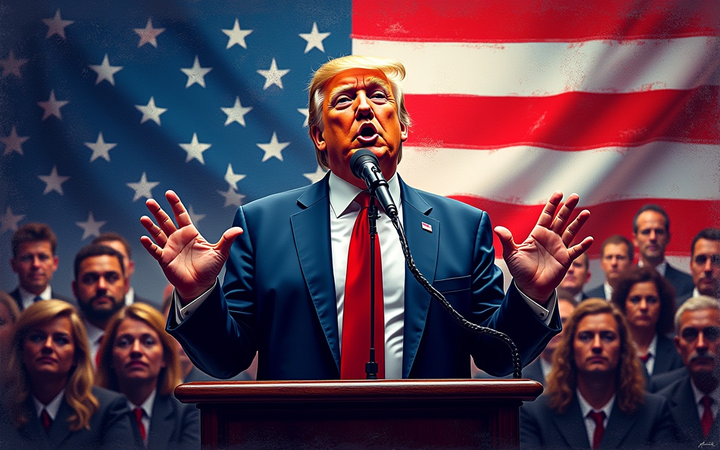
The most consequential national security move President Donald Trump has made this year came in two documents released late this year.
One redefined how the White House sees power, allies, and threats. The other decides who is allowed to enter the United States and who is not.
Taken together, Trump’s National Security Strategy and his new entry restrictions show a government that now treats borders, markets, and paperwork as frontline security tools, and is willing to upset allies and rivals alike to enforce that view.
What Trump’s National Security Strategy is really saying
Trump’s National Security Strategy is not built like the strategies that came before it. It spends less time listing enemies and more time explaining what the United States wants for itself.
Security is defined as sovereignty. That includes borders, industry, energy, and culture.
The document published by the White House on November 30 argues that decades of foreign policy focused on managing the world while neglecting the foundations of American power at home.
The strategy puts economic strength at the center. Manufacturing capacity, energy production, and technology leadership are described as the base of military power.
The message is that if the US cannot make things, fuel itself, and control key technologies, it cannot deter wars or shape outcomes abroad.
That logic explains why trade, tariffs, and supply chains receive more attention than traditional diplomacy.
This approach also explains the sharp tone toward allies. Europe is treated less as a security asset and more as a political problem.
The strategy questions Europe’s economic direction, demographics, and governance.
It argues that the US has carried too much of the burden for too long and that wealthy allies must take primary responsibility for their own defense.
This is not new in substance. What is new is the willingness to say it in official doctrine.
Why are rivals quieter in the document
One reason the strategy unsettled diplomats is what it does not emphasize. China and Russia are present but not framed as the defining threats of the era.
China appears mainly as an economic competitor whose rise was enabled by US policy failures. Russia is discussed through the lens of stability and ending conflict rather than confrontation.
North Korea wasn’t mentioned in the document. Similar to Venezuela, which the US is actively threatening.
This has led to claims that the US is going soft on adversaries, but that overstates the case. The strategy still calls for military strength, nuclear deterrence, and denial of regional domination.
It maintains US positions on Taiwan and supports Indo-Pacific partnerships. But it underplays the ideological and military nature of the challenge from authoritarian states.
That choice creates a perception problem. When Moscow publicly welcomes the document as closer to its worldview, allies take note.
Perception matters because it affects how partners plan, spend, and vote.
A strategy that signals toughness at home and ambiguity abroad can weaken coalitions even if troop levels and deployments stay the same.
Borders as national security policy in practice
The December 16 White House fact sheet shows how Trump’s National Security Strategy is being enforced. The expansion of entry restrictions is framed as a security measure based on data rather than ideology.
Countries are assessed on visa overstay rates, identity systems, information sharing, repatriation cooperation, and terrorist activity.
This is more of a compliance system than a travel ban. States that fail to provide reliable documents or accept deportees face full or partial restrictions. States that improve can see limits eased.
Turkmenistan’s partial relief is meant to prove the point. Access to the United States is conditional and reversible.
The scope is wide. Full restrictions now apply to more than a dozen countries, with additions in Africa and the Middle East. Partial restrictions cover many more.
Palestinian Authority-issued travel documents are included because US officials argue that vetting and control have collapsed.
The administration also narrowed family based immigration carve outs, citing fraud risks while keeping case-by-case waivers.
The logic mirrors the strategy. Migration is treated as a security threat upstream. If identity systems fail abroad, the risk shows up at the US border.
The response is pressure on governments rather than case by case humanitarian judgment.
The Supreme Court’s backing of Trump’s first-term restrictions gives the White House legal confidence to push further.
Economic leverage replaces reassurance
Trump’s National Security Strategy assumes that leverage works better than reassurance. Market access, investment, and technology are the tools of influence.
Allies are expected to align or pay more. Weak states are expected to reform or lose access. This approach fits Trump’s worldview and his political base, which is skeptical of foreign commitments that do not show a direct return.
It also explains the contradictions critics point out. The strategy speaks of non-intervention but asserts dominance in the Western Hemisphere.
It rejects ideological nation-building yet supports political forces abroad that align culturally with Trump’s agenda.
These tensions are not accidents. They point towards a belief that power comes from choosing sides openly rather than managing consensus quietly.
Analysts who argue the strategy is purely domestic messaging miss something important.
The policies that follow it are real. Entry restrictions, tariffs, and industrial policy reshape behavior even if the rhetoric is aimed at voters. At the same time, critics who see a full retreat miss the continuity.
The US is not abandoning alliances or forward forces but redefining what loyalty and partnership mean.
The risk of winning the argument and losing the room
Trump’s National Security Strategy is coherent in its own terms. It links borders, markets, and security into one framework. It uses data to justify exclusion and leverage to drive compliance.
It reflects a belief that America’s main weakness came from openness without control.
The risk lies in execution. Publicly scolding allies while softening language toward rivals can reduce trust faster than it increases burden sharing.
A compliance based immigration system can pressure weak states but also freeze them out permanently if they lack the capacity to reform.
Economic leverage works best when coordinated. Used alone, it can push partners to hedge rather than align.
What emerges from the documents is a United States that sees itself less as a manager of the global order and more as a gatekeeper. Who enters. Who trades. Who gets access to technology and capital?
The whole narrative is also aimed at a domestic audience. It’s not aimed at allies. That’s why some argue it’s more of a political message, rather than one aimed towards foreign policy.
The post What Trump’s National Security Strategy is really about appeared first on Invezz
