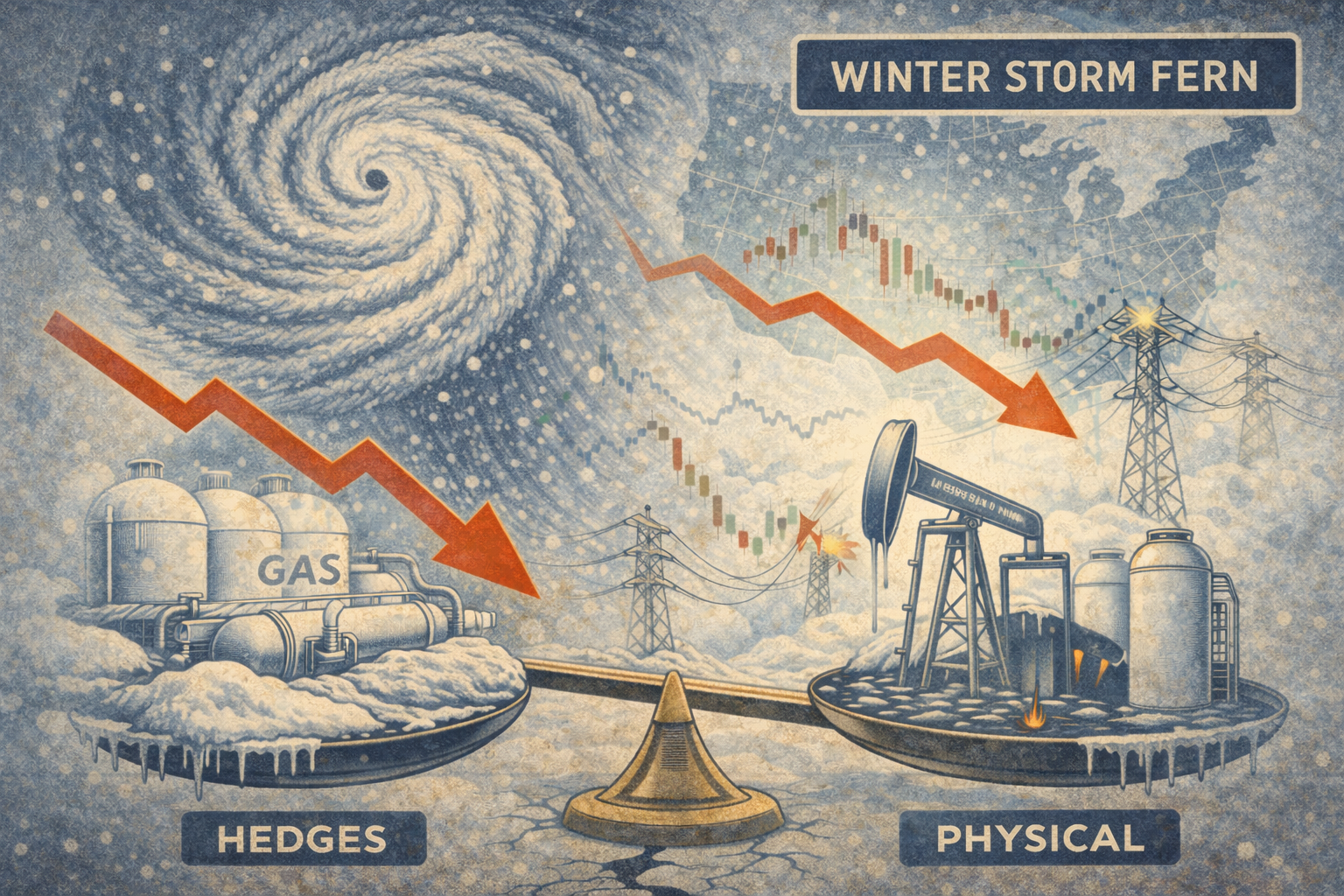
Winter Storm Fern hammered the US this weekend, and Rystad Energy has warned that the deep freeze will continue to wreak havoc on US onshore oil and gas production.
“Natural gas supply outages have emerged across the US in the wake of Winter Storm Fern, with an initial loss of 2 billion cubic feet per day (Bcfd) from the Bakken, Rockies and Mid-Continent, followed by a more abrupt drop of 12 Bcfd, primarily driven by the Permian and broader Gulf Coast region,” Matthew Bernstein, vice president, North America oil and gas at Rystad Energy said in an update.
Losses were somewhat limited in Appalachia.
US natural gas supply disruption
While current pipeline flow data shows specific figures, the expected peak loss estimate is approximately 20 Bcfd, according to Bernstein.
This higher total is due to the fact that flow data does not capture intrastate pipelines, particularly the more numerous ones in the Permian and Haynesville regions.
Conversely, regions such as Appalachia and the Bakken, which are generally more accustomed to severe winter weather, have maintained production quite well, according to pipeline data, showing only minor reductions, Bernstein added.
Rystad Energy expects the scale of the disruption to be greater than the January 2025 storm, yet similar in magnitude to the outages experienced in January 2022 and January 2024.
Quantifying impact on oil and gas output
Bernstein said:
Peak levels were reached today (Monday), and we expect significant outages to persist throughout the first half of the week followed by a swift recovery Sunday.
The initial pre-freeze assessment projects a January 2026 average of 104 Bcfd for the Lower 48 (excluding offshore Gulf), representing a 1.5 Bcfd reduction compared to the figures in our December US Oil & Gas Production Outlook, according to the update.
Rystad Energy projected that their base case showed a downside impact of 3.3 Bcfd, with a further potential reduction of 2.3 Bcfd possible.
This larger potential impact is mainly due to the risk of significant curtailment in the Permian basin, comparable to the event during Winter Storm Uri in 2021.
The initial 3.3 Bcfd assessment includes a 1.7 Bcfd reduction originating from Petroleum Administrative of Defense Districts (PADD) 3, which encompasses the Permian, Haynesville, and Eagle Ford regions.
In the chart below, Rystad Energy interprets outages from gas pipeline data into assessments on the impact of oil output, using the gas-to-oil ratio (GOR) as a means for the estimation.
Following the same analysis as for gas, Rystad Energy’s initial January pre-freeze assessment of 11.378 million barrels per day (bpd) for onshore Lower 48 will likely see a monthly average impact in January of 390,000 bpd – driven significantly by the Permian and PADD 3 more broadly.
The impact should be more limited in other oil regions like the Bakken, Rockies and the Mid-Continent.
Henry Hub price rebound and producer response
The 2026 Henry Hub price curve has rebounded to levels seen in early December for the March-December period, driven by both the immediate effects of the recent storm and increased demand due to a cold January.
However, the 2027 price curve remains largely unchanged from earlier January trade dates and is still lower than the 2026 curve.
The average price for the February-December 2026 period is currently $4.31 per million British thermal units (MMBtu), based on the market opening on January 26th.
This price change may encourage producers to increase their activity as they finalise their budgets for release in February.
Even so, operators may remain disciplined given the market volatility, having just faced bearish headwinds and a February-December 2026 average of $3.22 barely one week earlier.
The post Rystad forecasts 20 Bcfd US gas loss and oil output hit as winter storm Fern wreaks havoc appeared first on Invezz
